
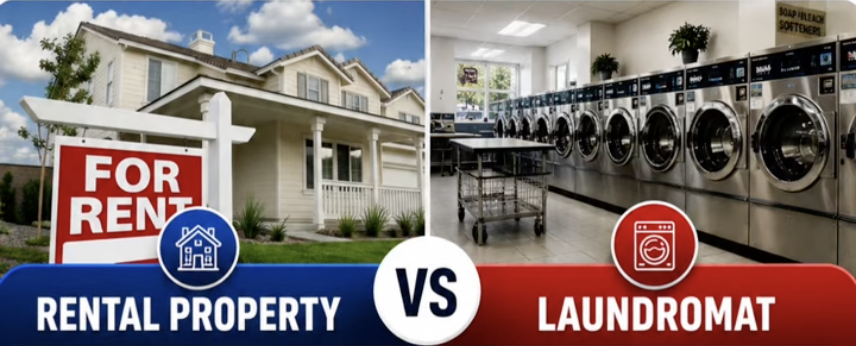
Most people think rental properties are the default path to passive income.
But what happens when you compare them to a laundromat?
Both can be acquired for roughly the same purchase price. Both generate recurring income. Both can be financed.
Yet once you look at the numbers and operating model, they are very different investments.
Rental Property vs Laundromat
For decades, rental properties benefited from three powerful tailwinds: falling interest rates, rising home values, and relatively affordable housing.
Many investors made excellent returns from appreciation even when the monthly cash flow was modest.
The challenge today is that many markets have become significantly more expensive.
Higher interest rates mean investors often need to deploy much more capital just to achieve a relatively small amount of monthly cash flow.
In many markets, finding a property that produces strong cash flow without taking on additional risk has become increasingly difficult.
Laundromats are one of the classic examples of a boring business.
People need clean clothes regardless of economic conditions. Revenue is collected immediately. There are no receivables and very little inventory risk.
That combination of recurring demand and strong cash flow is one reason more investors have started looking at laundromats.
Compared to many rental properties, the cash flow generated per dollar invested can be significantly higher.
What Stands Out About Rental Properties
- Potential appreciation: Real estate values may increase over time.
- Inflation protection: Rents often rise over long periods.
- Simple business model: Most people understand rentals.
- Access to leverage: Long-term financing is widely available.
- Tangible asset: You own the underlying real estate.
Potential Risks With Rental Properties
- Lower cash flow: Many markets produce thin margins after financing.
- Tenant risk: Non-payment, damage, and turnover can impact returns.
- Maintenance costs: Roofs, HVAC systems, plumbing, and major repairs add up.
- Property taxes and insurance: Both have increased substantially in many areas.
- Cash-flowing properties are harder to find: Especially in desirable neighborhoods.
What Stands Out About Laundromats
- Strong cash flow: Often much higher relative to the initial investment.
- Recurring demand: Laundry is a necessity, not a luxury.
- Immediate payment: Customers pay upfront.
- No tenant issues: You are not managing leases or evictions.
- Operational upside: Better pricing, marketing, and efficiency can improve returns.
Potential Risks With Laundromats
- Equipment replacement: Commercial washers and dryers can cost thousands of dollars each.
- High capex: A full refresh of machines can be a major expense.
- Utility costs: Water, gas, and electricity directly impact profitability.
- Business operations: Unlike a rental, this is an operating business.
- Competition: New laundromats can impact revenue if a market becomes oversaturated.
One reason business acquisitions have become increasingly popular is that many investors are struggling to find strong cash flow in traditional real estate.
That does not mean real estate is dead.
It simply means investors are expanding their search beyond rental properties and exploring operating businesses that may generate stronger immediate returns.
The numbers above help explain why.
A rental property is primarily a real estate investment.
A laundromat is primarily an operating business.
Both can build wealth. Both have risks.
The question is whether you would rather own a property that may appreciate over time, or a business that may generate significantly more cash flow today.