
Both are popular "passive" businesses. But they optimize for completely different outcomes.
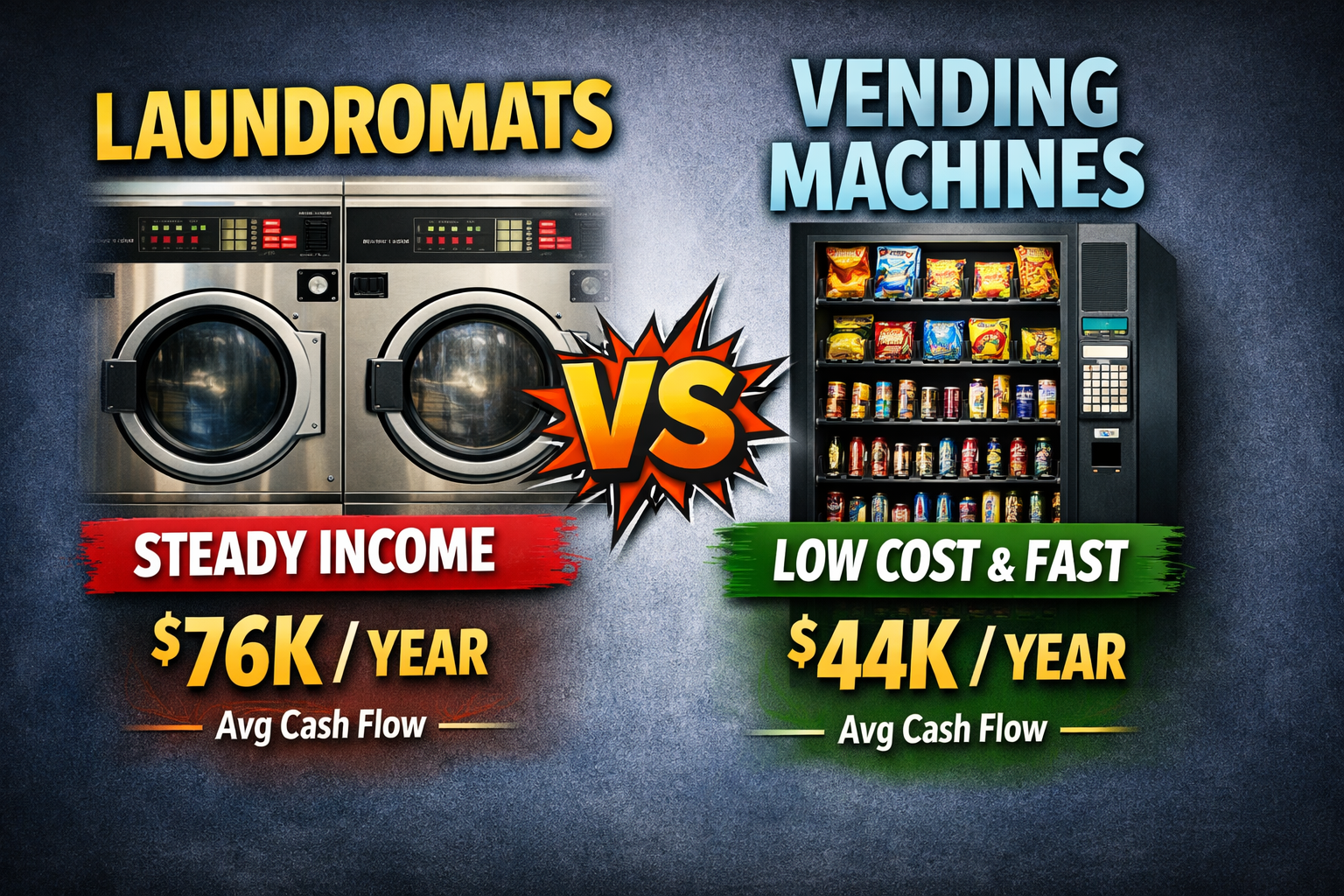
Laundromats and vending machines are two of the most talked-about entry points into small business ownership.
They are both seen as relatively simple, semi-passive, and cash-flow focused. But once you look at the numbers, they behave very differently.
Laundromat Snapshot
Laundromats tend to be steady, location-based businesses with consistent demand and relatively predictable usage.
Vending Machine Snapshot
Vending businesses are typically lower-cost, route-based operations with higher margins but smaller total income.
What Actually Matters
Side by side, the tradeoffs are clear.
- Total income: Laundromats generate significantly more cash flow.
- Margins: Vending machines are more efficient on a percentage basis.
- Entry cost: Vending is far cheaper to get into.
- Liquidity: Vending businesses sell faster on average.
- Risk profile: Laundromats have lower default rates.
- Valuation: Laundromats trade at higher multiples due to stability.
Operational Differences
These businesses also feel very different to run.
- Laundromats: Fixed location, higher upfront investment, more infrastructure.
- Vending: Route-based, easier to scale gradually, more frequent servicing.
- Maintenance: Both require upkeep, but laundromats involve larger equipment and utilities.
- Scalability: Vending can expand incrementally, laundromats scale through larger acquisitions.
So Which One Is Better?
It depends on your starting point and goals.
- If you want higher income and stability: Laundromats are the stronger long-term play.
- If you want a low-cost entry and faster deals: Vending machines are easier to start with.
- If you value simplicity and scale over time: Vending can grow step-by-step.
- If you want a more established, asset-backed business: Laundromats stand out.
BizHub Takeaway
Laundromats are steady, larger cash-flow businesses. Vending machines are lean, faster, and cheaper to enter.
Neither is universally better. They just solve for different constraints.
The right choice depends on whether you are optimizing for capital efficiency, total income, or speed.
Want to compare businesses like this with real data? Try the BizHub Deal Calculator →